- Arisa Waters LLC
- (602) 571-5875
- Mon–Sat: 6am–6pm, Sun: Closed
- michael@arisawater.com
 Skip to content
 Arizona water is hard because it sits over mineral-rich desert soil and limestone, which loads it with calcium and magnesium before it ever reaches your tap. Arizona has some of the hardest water in the U.S. — often 15–25+ grains per gallon, well above the national average.
The good news: hard water is safe to drink. The bad news: it quietly damages your plumbing, water heater, and appliances over time. Here’s what’s causing it, how to spot it, and how to fix it for good.
Arizona water hardness comes down to geology. Groundwater and reservoir water travel through limestone, gypsum, and mineral-dense desert soil before reaching your home. Along the way, it dissolves calcium and magnesium — the two minerals that define “hard” water.
A few Arizona-specific factors make it worse than most states:
This is why hard water Arizona isn’t a one-city issue, it’s a statewide reality, from small towns to major metros.
Water hardness is commonly measured in parts per million (ppm) or grains per gallon (GPG).
| Water Hardness | Approximate Level |
|---|---|
| Soft | 0–60 ppm |
| Moderately hard | 61–120 ppm |
| Hard | 121–180 ppm |
| Very hard | Over 180 ppm |
Many areas of Arizona have water that falls into the hard or very hard range. Phoenix hard water, for example, is a common concern for homeowners because mineral-heavy water can leave visible scale on plumbing fixtures and appliances. Your exact hardness level depends on your local water source and home.
Yes. While hard water is generally safe to drink, prolonged exposure can create problems for your home’s plumbing system.
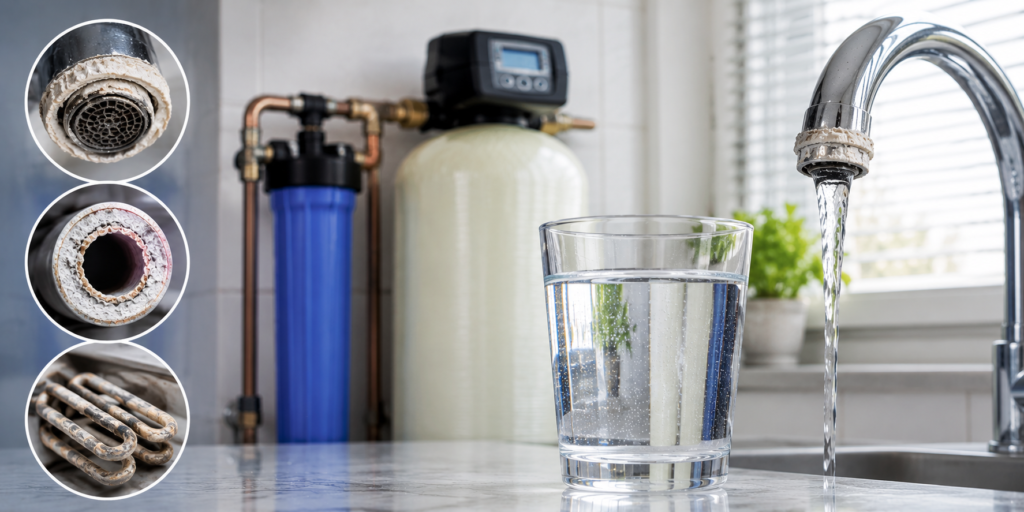
Mineral scale can accumulate inside pipes and fixtures. In water heaters, deposits can build up around heating elements and inside the tank.
Over time, this can contribute to:
The severity depends on your home’s water hardness, plumbing system, water usage, and how long mineral buildup has been occurring.
Not sure if your water is hard? These are the everyday hard water signs Arizona homeowners deal with:
If you’re seeing two or more of these, it’s a strong sign your home needs a hard water solution not just a cleaning product.
Yes. Hard water is safe to drink. Calcium and magnesium are minerals, not contaminants, and the EPA does not regulate water hardness as a health risk. Some people even prefer the taste.
The real cost of hard water isn’t health — it’s your home. Mineral buildup shortens the life of water heaters, clogs pipes, damages washing machines and dishwashers, and forces appliances to work harder, which raises energy bills over time.
The right solution depends on your home’s water hardness and what you want to improve.
For homeowners dealing with ongoing hard water, a water softener is usually the best long-term fix.
A traditional water softener uses an ion-exchange process to reduce calcium and magnesium before the water reaches your home’s plumbing.
This can help reduce:
If you’re searching for a water softener installation in Arizona. Most homeowners use for whole-home protection, start by testing your water and determining the actual hardness level.
A water filtration system can address specific contaminants or improve taste and odor, depending on the system.
However, standard filters aren’t automatically a replacement for a water softener. The two systems solve different water-quality problems.
If your main concern is better-tasting, cleaner drinking and cooking water, a dedicated drinking water system can provide an additional level of treatment at the kitchen sink.
This can be especially useful when paired with whole-home water filtration systems.
Hardness isn’t the only water-quality concern homeowners may have. If you’re worried about microorganisms or other specific water-quality issues, a properly selected treatment system may address those concerns.
The important point is to test first and treat based on the actual problem, rather than installing a system simply because it is marketed as a universal solution.
A water softener uses ion exchange to swap calcium and magnesium for sodium or potassium ions, stripping the hardness out of your water supply before it hits your plumbing. That means:
Given how mineral-heavy Arizona’s water supply is, a softener isn’t a luxury upgrade here — it’s standard maintenance for protecting your home.
Start with a water test.
Testing can help identify your home’s hardness level and reveal whether there are other water-quality concerns worth addressing.
Once you know what’s actually in the water, a water treatment professional can recommend a system based on:
This approach is more reliable than choosing a system based only on symptoms.
Because Arizona's groundwater and Colorado River supply both travel through mineral-rich desert soil and limestone, picking up high levels of calcium and magnesium before reaching your home.
Arizona is consistently ranked among the states with the hardest water in the U.S., with many areas testing well above the national average for grains per gallon.
Yes — simple test strips give a rough reading. For an accurate number and treatment recommendation, a professional water test is more reliable.
Most do. Given how widespread hard water is across Arizona, a softener is one of the most cost-effective ways to protect plumbing and appliances long-term.
Arisa Water LLC specializes in diagnosing and solving hard water problems across Arizona. Our team tests your water, explains exactly what’s causing the hardness, and installs the right water softener in Arizona homeowners rely on to protect their pipes, water heater, and appliances for years to come.
Beyond softening, we also offer complete water treatment solutions if you’re dealing with more than just hardness:
Water Treatment Services — full-home assessments and treatment plans
Water Softener Systems — the long-term fix for hard water
Bacteria Guard System — protection against bacterial contamination
Drinking Water System — clean, great-tasting water straight from the tap.
You don’t have to guess whether hard water is damaging your home. Arisa Water LLC offers fast, straightforward water quality checks so you know exactly what’s in your water and what it’s costing you.
Arisa Water LLC is dedicated to providing dependable residential water treatment solutions throughout West Valley, AZ.
 Optimized by Seraphinite Accelerator