- Arisa Waters LLC
- (602) 571-5875
- Mon–Sat: 6am–6pm, Sun: Closed
- michael@arisawater.com
 Skip to content
Yes, most Arizona homes benefit from a water softener. Water across Phoenix, Tucson, Scottsdale, Mesa and most of the state is classified as hard to very hard, often 10 to 20+ grains per gallon (GPG), mainly because of dissolved calcium and magnesium. If you see white scale on faucets, spots on dishes, dry skin, or stiff laundry, your home is almost certainly dealing with hard water.
Yes. Arizona’s water comes from the Colorado River (through the Central Arizona Project), the Salt and Verde rivers (through SRP), and groundwater. All of these pick up minerals as they travel through desert rock and soil.
Hard water is water with high levels of dissolved calcium and magnesium. The USGS classifies hardness like this:
Hardness Level | mg/L (ppm) | Grains per Gallon (GPG) |
|---|---|---|
Soft | 0 to 60 | 0 to 3.5 |
Moderately hard | 61 to 120 | 3.6 to 7 |
Hard | 121 to 180 | 7.1 to 10.5 |
Very hard | 181+ | 10.6+ |
Hardness varies by city, neighborhood and water source, and many Arizona areas land in the “very hard” range. For your exact numbers, check your city’s annual water quality report (the City of Phoenix Water Services Department and other utilities publish them) or test your water at home.
Hard water is not automatically unsafe to drink. The City of Phoenix explains that hardness itself is an aesthetic concern rather than a regulated health-based drinking water standard. If you have concerns about contaminants, check your local water quality report and test for the specific substances you want to evaluate.
The important question is whether your home’s water hardness is causing problems that you want to address.
That chalky white or greenish buildup is limescale, left behind when hard water evaporates. In Arizona’s dry heat, water evaporates fast, so scale forms quickly. If you scrub your fixtures every few weeks and the buildup keeps coming back, hard water is the cause.
Cloudy glasses and spotted dishes straight out of the dishwasher are a classic sign. The spots are mineral deposits, not dirt. Rinse aid helps a little, but it does not remove the minerals from your water.
Hard water reacts with soap and leaves a film on your skin and scalp. Many people notice itchy, tight skin and hair that feels rough after showering. Some people with eczema or sensitive skin report improvement after switching to softened water, though results vary and you should talk to a doctor about skin conditions.
Minerals get trapped in fabric fibers. Towels feel scratchy, whites turn dingy, and colors fade faster. You may also find yourself using more detergent than the label recommends.
Scale slowly narrows the inside of pipes, showerheads and faucet aerators. If pressure has dropped gradually over time (and there is no leak or utility issue), mineral buildup in your plumbing is a likely cause.
Scale forms on heating elements inside water heaters, dishwashers and washing machines. A layer of scale makes the heater work harder, which can raise energy use and shorten the appliance’s life. If your water heater is noisy (popping or rumbling sounds), scale on the tank bottom is often the reason.
If soap and shampoo barely foam, and you keep seeing a sticky film on tubs, tiles and shower walls, that is soap scum. It forms when soap reacts with calcium and magnesium. Soft water lathers easily and rinses clean.
Rule of thumb: if you notice three or more of these signs, a water softener is worth serious consideration.
You can confirm hard water in three ways:
Quick home check: fill a clear bottle one-third with tap water, add a few drops of pure liquid soap, shake for 10 seconds. Few suds and cloudy water suggest hard water.
A traditional salt-based water softener uses ion exchange. Water flows through a tank of resin beads that capture calcium and magnesium and release sodium or potassium in their place. The result is soft water that protects pipes and appliances and helps soap work properly.
A softener does not make water purified. It is designed for hardness, not for removing contaminants.
System | Main Job | Removes Hardness? | Best For |
|---|---|---|---|
Salt-based water softener | Removes calcium and magnesium | Yes | Whole-house hard water problems |
Salt-free conditioner (descaler) | Changes how minerals form scale | No, it reduces scale only | Homes wanting low maintenance or in areas that restrict salt systems |
Carbon water filter | Reduces chlorine, taste and odor | No | Better tasting water |
Reverse osmosis (RO) | Removes many dissolved solids and contaminants | Partly, at one tap | Drinking and cooking water |
Many Arizona homeowners combine a whole-house softener with an RO system at the kitchen sink for the best results.
Prices vary by system size, brand and installation. As a general guide:
Get a written quote that includes installation, warranty and sizing based on your household size and hardness level. Prices change, so confirm with a local professional.
Pros
Cons
If your goal is to truly remove hardness, a salt-based softener is the proven option. If you mainly want to reduce scale with less maintenance, or live where salt systems are restricted, a salt-free conditioner may fit. A local specialist can recommend the right choice after testing your water.
For most homes, yes. Arizona's hard water causes scale buildup that can damage appliances and plumbing over time. A softener reduces cleaning, protects equipment and improves how water feels.
Look for scale on faucets, spotted dishes, dry skin, stiff laundry, low pressure and soap scum. A water hardness test gives a definite answer.
Yes, in general. Salt-based softeners add a small amount of sodium. If you are on a low-sodium diet, ask your doctor, or use a potassium-based option or an RO drinking water tap.
With proper maintenance, a quality softener typically lasts 10 to 15 years.
Yes. Scale reduces efficiency and can shorten the life of water heaters, dishwashers, washing machines and coffee makers.
Usually yes. Standard filters do not remove calcium and magnesium. Filters and softeners solve different problems.
Not for removing hardness. Salt-free systems reduce scale formation but do not remove the minerals.
Arisa Water LLC removes hardness at the source with professional water treatment. We start with a water test to measure your hardness level in grains per gallon (GPG) and check for other issues like chlorine or iron. Based on the results, we recommend a salt-based softener or another solution, sized for your household’s water use. This way, calcium and magnesium are removed before they can cause scale on your fixtures, appliances, and pipes.
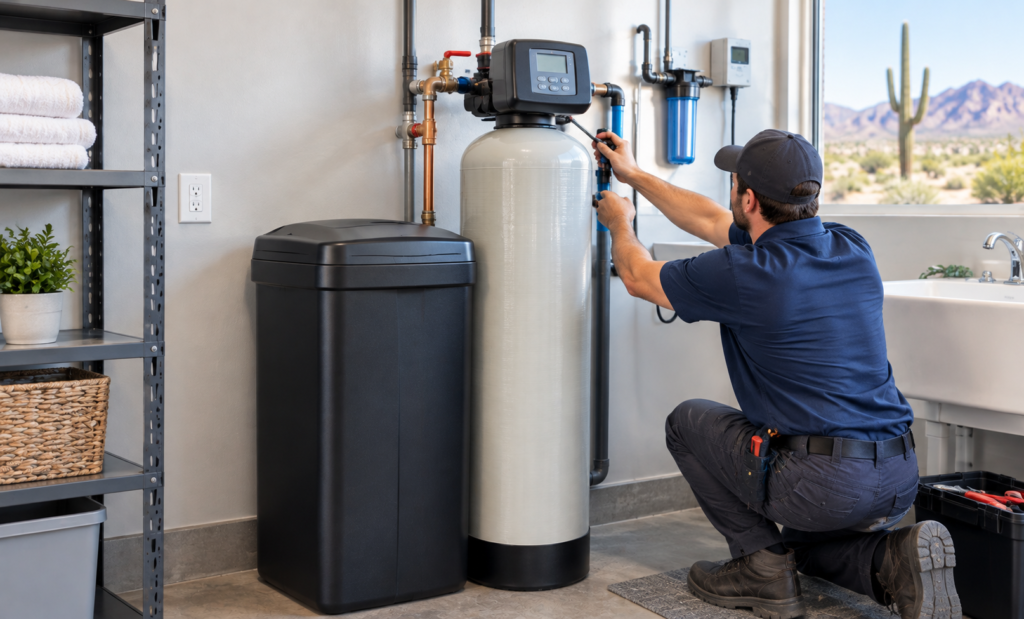
Our water softener installation services cover everything from start to finish. Our technicians install the system on your main water line, connect the drain and bypass valve, program the settings, and test the water for softness before we leave. We also explain salt refills and basic maintenance, so your system keeps performing for years. Contact Arisa Water LLC today for a water test and a custom quote.
Sources to link in this post: USGS Water Hardness page, EPA drinking water information, your city’s annual water quality report, Water Quality Association (WQA), NSF International.
Contact Arisa Water LLC at (602) 571-5875 for a free water test and a custom softener quote in glendale, perior, goodyear, sun city, AZ.
Arisa Water LLC is dedicated to providing dependable residential water treatment solutions throughout West Valley, AZ.
 Optimized by Seraphinite Accelerator