- Arisa Waters LLC
- (602) 571-5875
- Mon–Sat: 6am–6pm, Sun: Closed
- michael@arisawater.com
 Skip to content
 The fastest way to test your home’s water hardness in Arizona is with an EDTA drop-count test kit, which gives you a reasonably accurate grains-per-gallon (GPG) reading in under five minutes. For the most reliable results especially before sizing a water softener send a sample to a certified laboratory. Soap tests and test strips work too, but they only give rough estimates.
Most Arizona homeowners already suspect they have hard water. The real question is how hard, and that number is what determines which fix actually works.
Arizona homeowners commonly deal with mineral-rich water. Calcium and magnesium are the primary minerals responsible for water hardness. As water moves through the ground and local water systems, it can pick up these naturally occurring minerals.
Hard water is not necessarily something you can identify by appearance alone. Instead, homeowners often notice its effects over time, including:
Testing gives you a number instead of relying only on these signs.
It is also smart to perform a water hardness test before choosing a water softener installation. The hardness level can help determine how much treatment capacity your household may need.
Local water conditions can vary between communities and water sources. Homeowners in Phoenix, Mesa, Scottsdale, Tucson, and the West Valley may have different water characteristics depending on their specific supply.
For general information about your area, check your water provider’s Consumer Confidence Report (CCR). These reports can provide useful information about the local water supply, although they do not necessarily tell you the exact hardness level at your individual home’s tap.
For a home-specific answer, testing your own water sample is more useful.
There’s no single “best” method for everyone. It depends on how precise you need the answer to be.
A simple soap test can help you how to tell if you have hard water, but it should only be treated as a basic indication. Fill a clear bottle about a third full with water, add a few drops of pure liquid soap, and shake it hard for a few seconds.
This test is useful as a first check, but it’s not a measurement. It won’t tell you your actual GPG or ppm level, so don’t rely on it to size a softener or make a purchase decision.
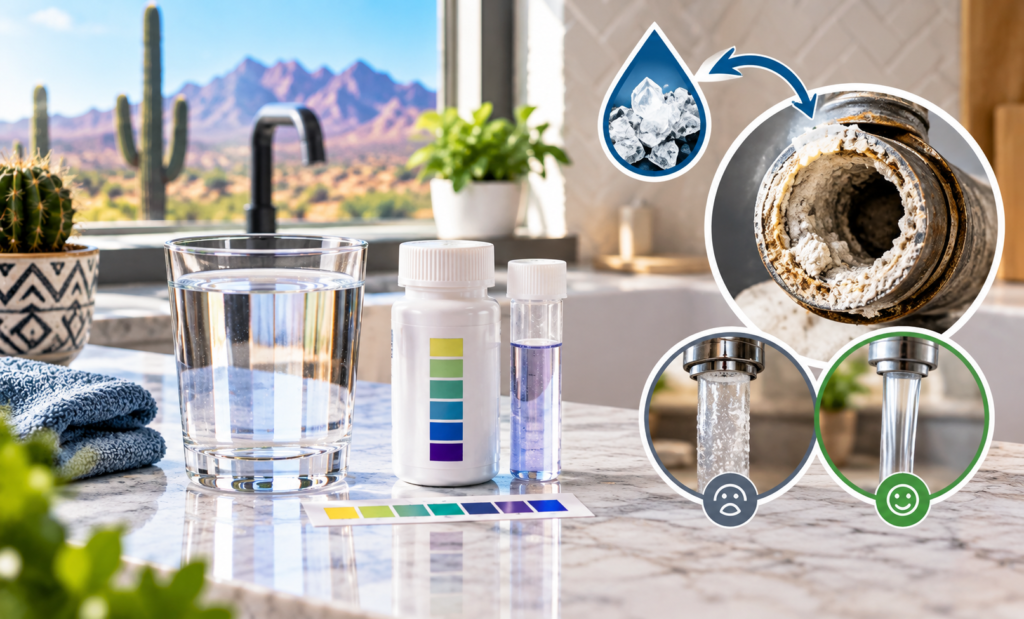
Hardness test strips are one of the easiest ways to test water hardness at home.
Most strips work by dipping the strip into a water sample for a specified amount of time. The color is then compared with a chart supplied with the kit.
Depending on the product, results may be displayed in:
A water hardness test kit is convenient and inexpensive, but test strips provide an estimate rather than a complete water analysis.
For routine screening, strips can be useful. If you need a more precise measurement for water treatment decisions, consider a drop-count test or laboratory analysis.
An EDTA drop-count kit works by adding a reagent to a water sample one drop at a time until the liquid changes color. You count the drops, and that count converts directly to a hardness reading in grains per gallon.
This method is significantly more accurate than strips or soap because it’s based on a chemical titration reaction rather than a visual color match. It’s the method most water treatment professionals recommend for homeowners who want a dependable number without sending a sample out.
Note on TDS meters: A TDS (total dissolved solids) meter is a different tool. It measures the overall concentration of dissolved minerals and salts in water, but it does not measure hardness on its own; calcium and magnesium are only part of what a TDS reading includes. A high or low TDS number doesn’t tell you your GPG hardness level.
For the most accurate and complete picture, send a water sample to a certified lab. Lab testing measures hardness precisely and can also flag other minerals and contaminants that DIY kits don’t check for.
If you’re about to invest in a water softener or whole home filtration system, a certified lab test or a professional in-home water test is the most reliable way to size the system correctly the first time.
Whichever method you choose, sample collection matters. Here’s how to do it correctly:
Once you have a number, here’s how to read it:
Hardness Level | Grains Per Gallon (GPG) | Parts Per Million (ppm) |
Soft | Less than 1 GPG | Less than 17 ppm |
Moderately Hard | 1 – 7 GPG | 17 – 120 ppm |
Hard | 7 – 10 GPG | 120 – 180 ppm |
Very Hard | Over 10 GPG | Over 180 ppm |
Most homes across the Phoenix metro and Tucson area test in the “hard” to “very hard” range, though the exact number varies by neighborhood, well source, and municipal treatment process.
If your DIY test comes back in the “hard” or “very hard” range, that’s the point where a certified lab test or professional in-home assessment makes sense — it confirms the number and rules out other water quality factors before you spend money on equipment.
Hardness levels vary by city and even by neighborhood, since water comes from a mix of groundwater wells, the Colorado River, and the Salt River Project depending on where you live.
Your local water utility publishes an annual Consumer Confidence Report (CCR), which can give you a general idea of typical hardness levels in your area. It’s a useful starting point, but it reflects an average for your utility’s service area, not your specific tap. A home test still gives you the number that applies to your actual water.
The right method depends on why you’re testing.
The goal is not simply to confirm that your water is hard. It is to determine how hard it is so you can make an informed treatment decision.
Common signs include white mineral deposits around faucets, spots on dishes, soap that does not lather easily, and scale on plumbing fixtures. However, these signs are not a substitute for testing. A water hardness test gives you a measurable result.
Common signs include white scale on faucets and showerheads, soap that doesn't lather well, spots on dishes and glassware, and dry skin or dull-feeling hair after showering. These are strong hints, but a test is the only way to get an actual number.
An EDTA drop-count kit is more accurate than soap tests or strips because it's based on a chemical reaction rather than a visual estimate. For the most reliable number, a certified lab test is best.
Not on its own. A TDS meter measures total dissolved solids, which includes more than just calcium and magnesium. It's not a substitute for a dedicated hardness test.
Yes, most of Arizona has hard to very hard water due to the mineral content in groundwater and surface water sources. Exact levels vary by city and neighborhood, so a local test is still the best way to confirm your number.
Not automatically. It depends on how hard your water is and what issues you're noticing scale buildup, appliance wear, or soap inefficiency. A hardness reading in the "hard" or "very hard" range is generally when a softener starts to make a practical difference.
DIY kits are a great starting point, but if you’re planning to invest in a water softener, an accurate number matters. Arisa Water LLC offers professional water hardness testing across the Phoenix metro, Tucson, and West Valley areas to help you get a precise reading and the right system for your home.
Arisa Water LLC is dedicated to providing dependable residential water treatment solutions throughout West Valley, AZ.
 Optimized by Seraphinite Accelerator